Codex Daemons & Overnight Crons
The context triad, agent archetypes, and work that happens overnight.
What you'll learn
- Bundle the context triad — intent, implementation, and live output — for diagnosis
- Run specialized Codex daemons as overnight emulated crons
- Coordinate agents through natural-language loose coupling
In a nutshell
John revisits PackX as a way to bundle QA artifacts so a model can compare intent, implementation, and output. He then talks through reusable specialized Codex daemon-style agents, short plain-English /goal files, Oracle-generated goal files for complex work, a timestamp-based workaround for overnight loops, and the importance of keeping team and tool workflows flexible through natural-language contracts.
Key concepts, explained
Context triad: intent, implementation, output
For difficult debugging, John teaches bundling the expected behavior, the relevant code, and the observed runtime evidence. The evidence can include logs, console output, screenshots, traces, performance profiles, QA-script artifacts, and other files produced while the app is actually running.
Why it matters Models reason better when they can compare what should have happened, how the code attempted it, and what actually happened during execution.
QA artifacts as live application evidence
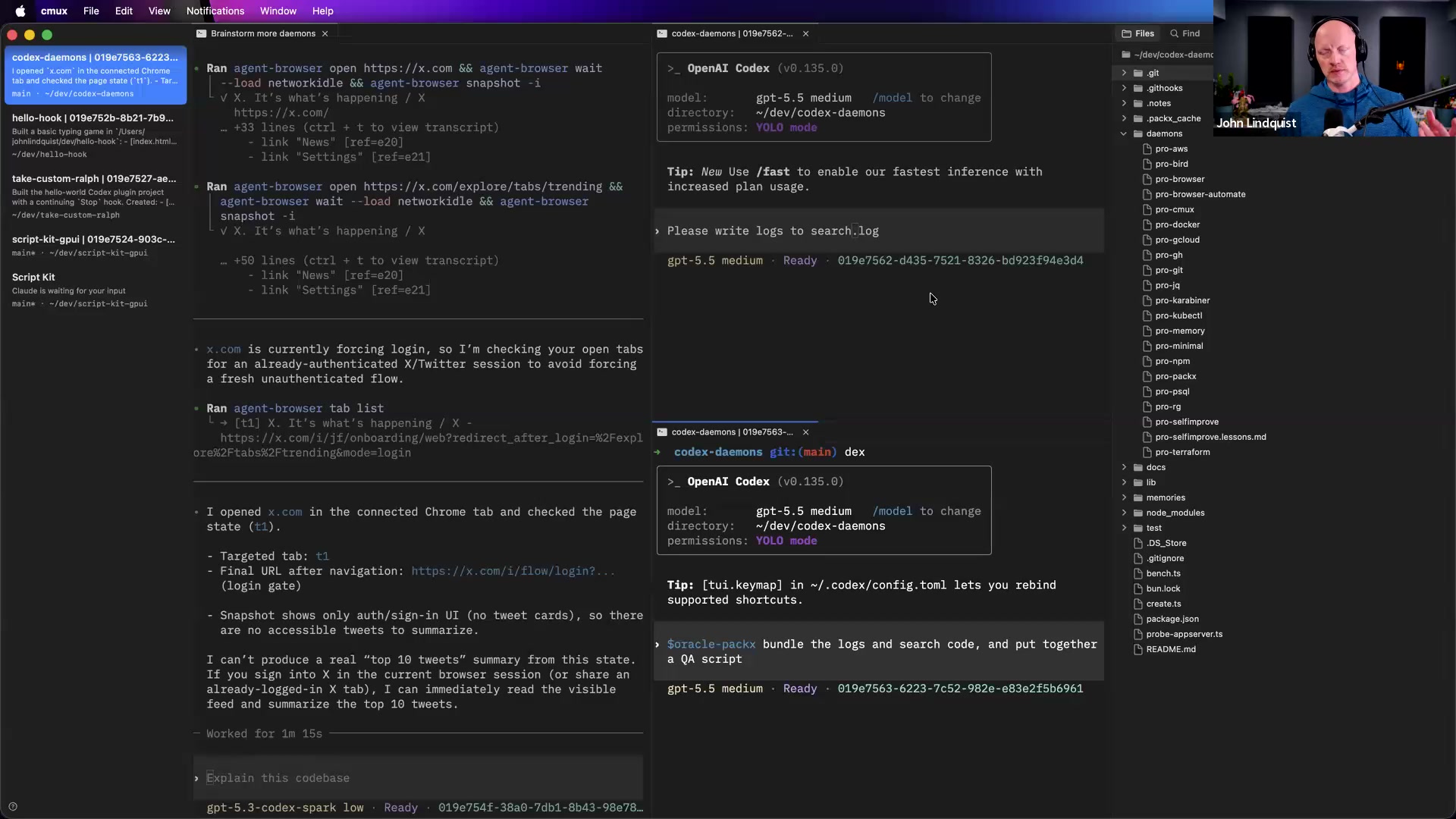
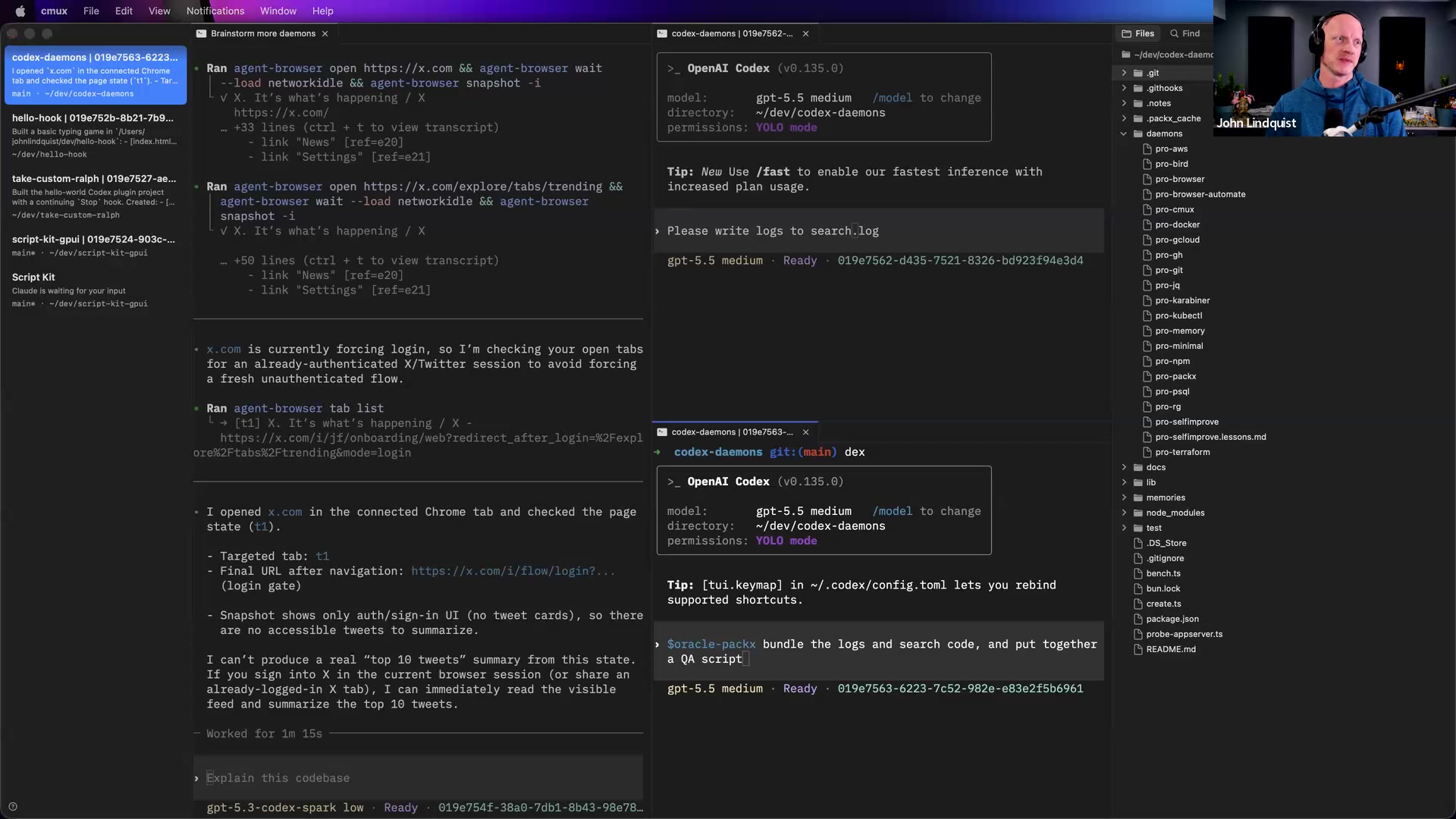
John describes logs as a representation of the live app running and recommends shaping QA scripts and project-specific dev tools so they deliberately write useful artifacts. Those artifacts can then be bundled with code using PackX or another bundler for analysis by a stronger model.
Why it matters A model that sees real artifacts from a user flow can diagnose behavior instead of guessing from source files alone.
Specialized agents and Codex daemons
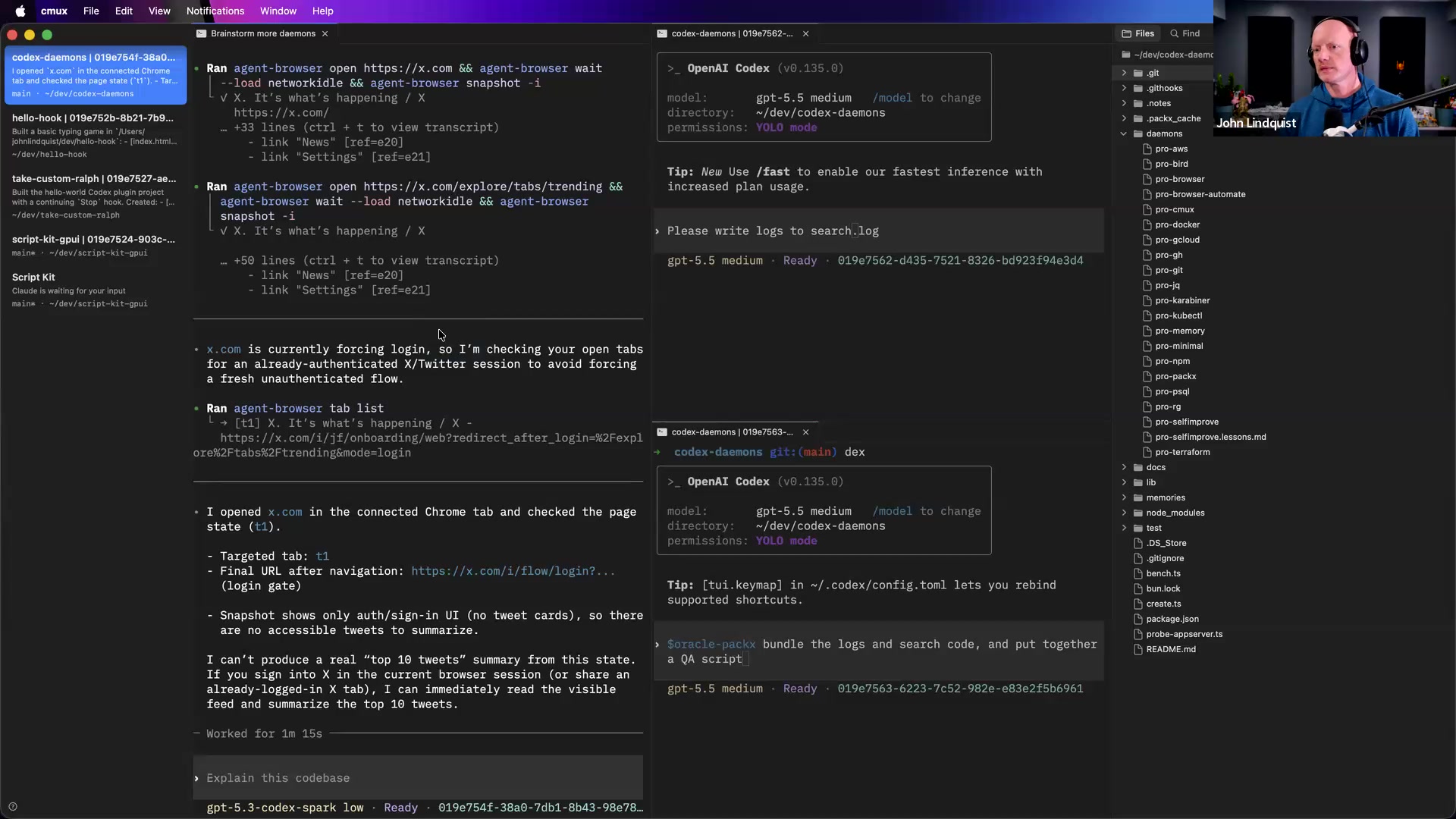
John connects Planner, Builder, Researcher, and Validator-style responsibilities to specialized agents. His Codex daemon point in this section is high level: create custom, reusable agents for a specific project need, give them the relevant requirements, and reuse them instead of making one agent handle everything.
Why it matters Custom systems that understand your project can support workflows that generic shared skills may not cover.
Short /goal files and Oracle-generated plans
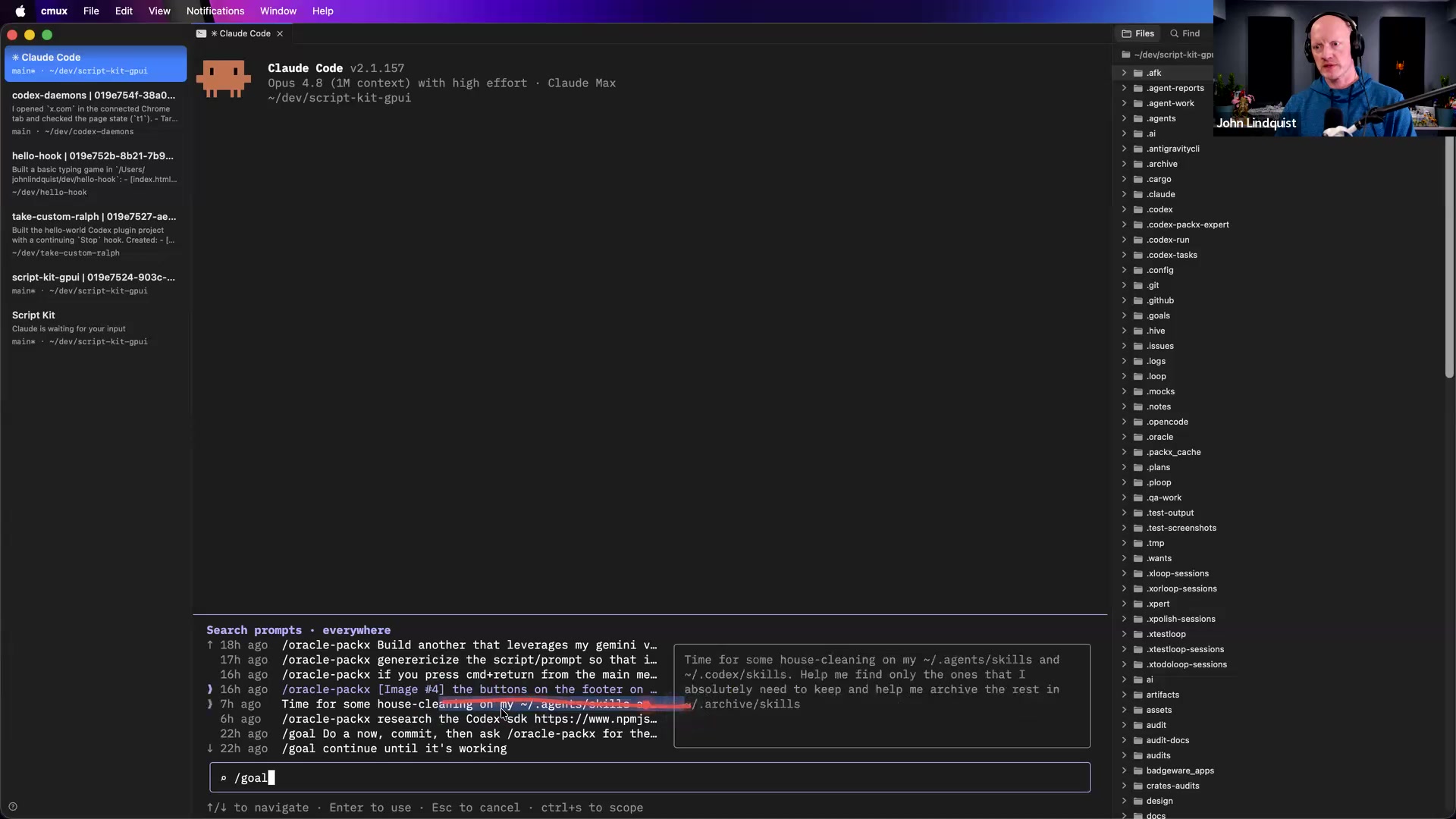
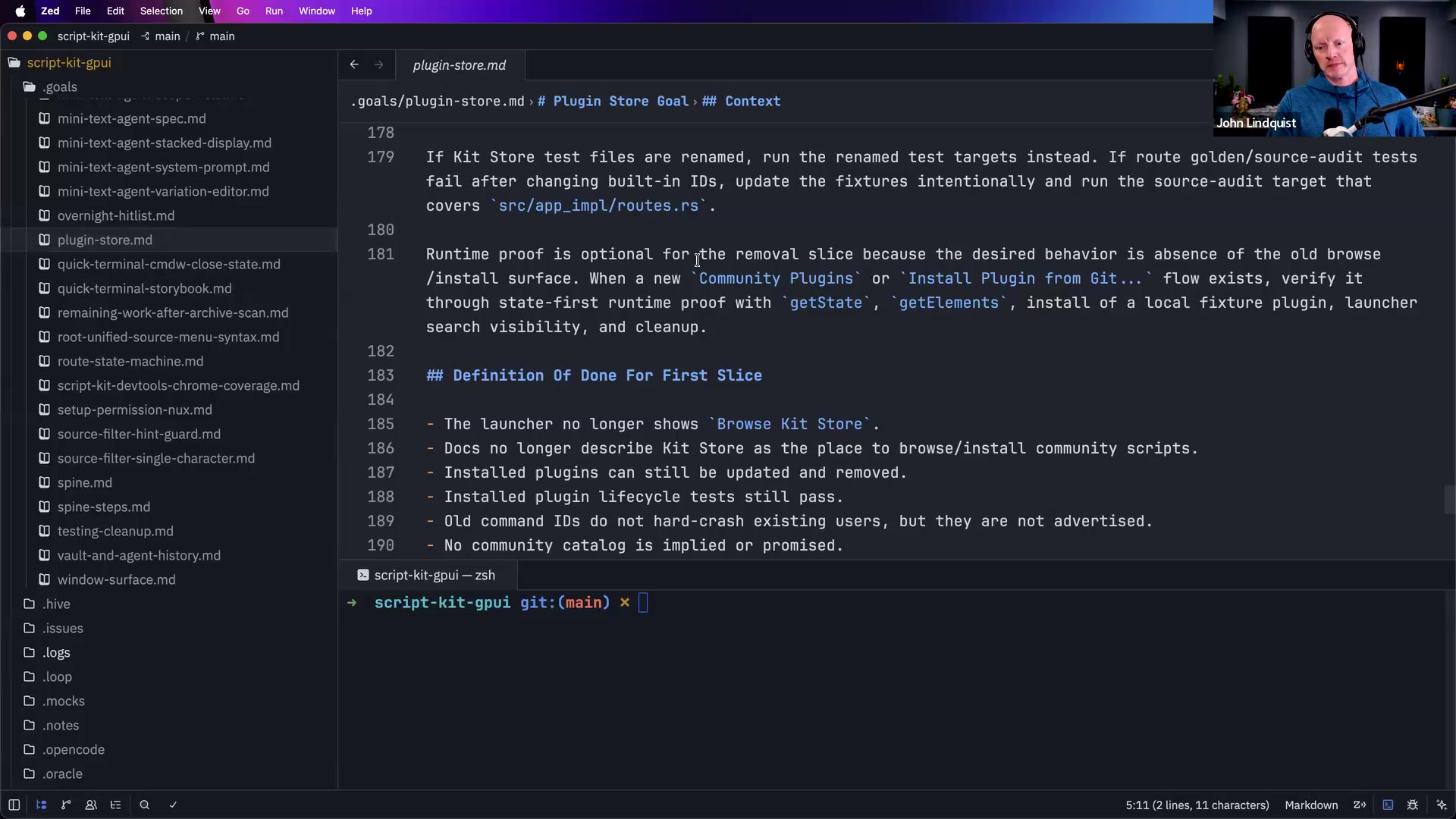
John shows that many of his goal prompts are plain and short, such as asking for a specific layout fix. For complex work, he often asks Oracle to research the problem and generate a more detailed goal file, then drops that file into his `.goals` directory for Codex to run through research, implementation, and verification.
Why it matters Simple tasks do not need massive prompts, while complex tasks benefit from a stronger planning pass before Codex executes the work.
Overnight emulated crons
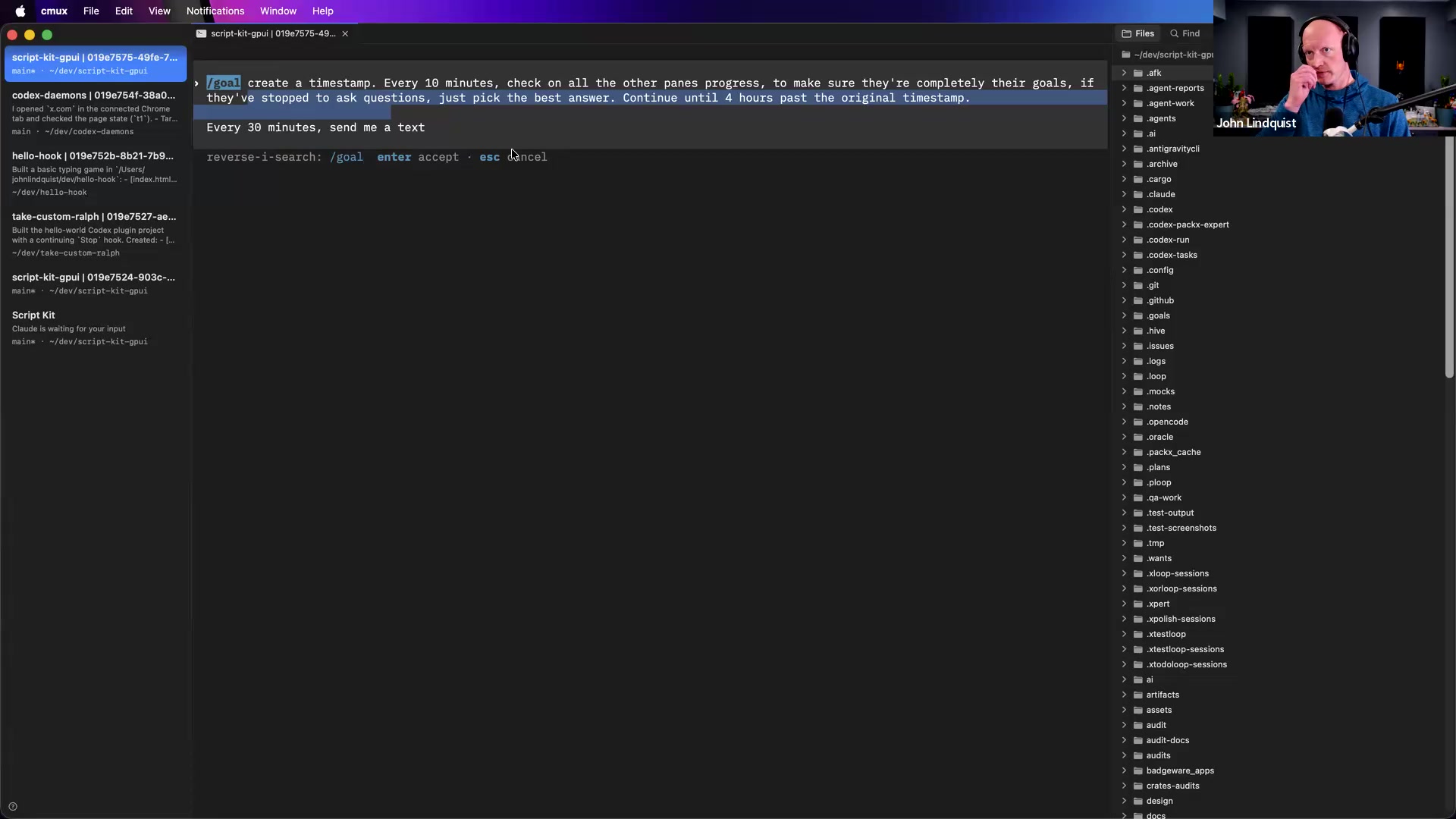
Because Codex does not have a built-in cron in this workflow, John describes writing a goal that creates a timestamp, repeats a task every 10 minutes, and continues until a fixed duration or target time such as 9 AM.
Why it matters This gives Codex a bounded long-running loop without pretending it is a real scheduler.
Natural-language loose coupling
For team workflows and tools, John recommends staying flexible: capture meetings and workflow complaints, iterate on how the team works, and prefer open-source, agent-first tools whose main contract is natural language. He uses the ability to abandon a tool easily as the point.
Why it matters Tools are changing quickly, so teams should avoid investing too heavily in brittle workflows tied to one vendor or interface.
Curated references
A bundling tool John uses to package code, logs, screenshots, traces, and other artifacts into a single context bundle for model analysis.
Reach for it when Reach for it when a difficult bug needs the full intent, implementation, and output picture instead of code alone.
codex-daemons
github.com/johnlindquist/codex-daemonsJohn’s specialized Codex daemon project/concept, discussed here at a high level as a way to create reusable agents customized for a project need.
Reach for it when Study it when you want to build a focused reusable Codex helper instead of relying on one broad agent for every responsibility.
Agent Browser
www.npmjs.com/package/agent-browserA web-app verification tool John names as an example of collecting Chrome DevTools console logs and screenshots as live-run artifacts.
Reach for it when Use this pattern when verifying a web project and you need browser evidence to bundle with source and intent.
Oracle
🔍 John Lindquist Oracle Codex goal filesJohn’s name in this workshop for a stronger planning and analysis workflow he uses to inspect bundles and generate detailed goal files.
Reach for it when Use this pattern when a task is complex enough that you want research, implementation, and verification planned before handing the goal to Codex.
ScreenPipe
🔍 ScreenPipe screen recording workflow analysisA tool John uses as an example of capturing observational screen data so an agent can analyze how you work and suggest workflow improvements.
Reach for it when Consider the pattern when you want to feed agents relevant observational data about your work; in this section it was an example, not a Codex daemon requirement.
Recommendations & best practices
- For hard bugs, do not send code alone. Bundle the stated intent, relevant implementation, and runtime output such as logs, screenshots, traces, performance profiles, and console errors.
- Shape QA scripts and project-specific dev tools to produce artifacts deliberately; do not wait until a failure and then wish you had logs.
- Use short, plain-English `/goal` prompts for simple tasks. John’s examples were not hyper-specific; they named the concrete thing to fix or investigate.
- For complex work, have a stronger planning or research pass produce a goal file, then run that file from `.goals/` so the research context flows into implementation and verification.
- Use specialized Codex daemon-style agents for recurring project roles, but keep the claim high-level: customize the agent with requirements and reuse it.
- For overnight work, write the loop into the goal with a timestamp, interval, and stop point such as four hours later or 9 AM.
- For team workflows, capture meeting or stand-up transcripts, look for repeated complaints or friction, and keep tool contracts flexible enough to swap tools when the ecosystem changes.
Make it stick
Practice building evidence-rich context bundles, short goal files, specialized Codex helpers, and bounded overnight loops without turning them into one giant magical agent.
🧩 Quick quiz
1. A web app test is failing, but the source code alone does not make the cause obvious. What context bundle gives Codex the best chance of diagnosing it?
2. What is John’s practical point about Planner, Builder, Researcher, and Validator-style responsibilities?
3. What is the key safety and control feature of an overnight emulated cron prompt?
4. In this section, what did John actually teach about Codex daemons?
5. What does natural-language loose coupling mean in this lesson?
✅ Try it yourself
🚀 Challenges
Build a Context Triad Debug Bundle
EasyPick one failing test or bug. Create `intent.md`, capture the failing command output into `execution.log`, include the smallest relevant source files, and ask Codex to identify where output diverges from intent.
Done when: Codex can point to a specific mismatch between expected behavior, implementation, and runtime evidence instead of giving generic advice.
Write a Plain-English Goal Flow
MediumTake a medium-sized change and draft a short `/goal` that asks for research, implementation, and verification. Name the artifact or tool that should prove the result, such as logs, tests, browser output, screenshots, traces, or a QA script.
Done when: The goal is short enough to understand quickly, but clear enough that the agent knows what to investigate, what to change, and how to verify it.
Design an Overnight Investigation Loop
MediumWrite a `.goals/overnight-investigation.md` file that tells Codex to create a timestamp, run an investigation every 10 minutes, record findings, and stop after a fixed duration or target clock time.
Done when: The goal file contains the loop interval, artifact path, and stop condition, and it does not describe an unbounded keep-working-forever task.
Draft a Specialized Codex Daemon Brief
HardChoose one recurring project need, such as planning a change, researching an API, verifying a web flow, or packaging context. Draft a brief for a reusable specialized Codex helper: what it is for, what project context it needs, and what output it should return.
Done when: Another developer can tell exactly what the helper is for, when to use it, and what useful artifact it should produce.
Turn a Meeting Transcript into Workflow Feedback
MediumTake a real or sample engineering meeting transcript and ask an agent to extract repeated complaints, workflow friction, what is working, and one concrete process improvement to discuss with the team.
Done when: The output identifies specific team workflow issues from the transcript rather than producing generic AI SDLC advice.
💭 Reflect
- Where are you currently asking one goal or agent to do too much, and which responsibility would become clearer if you split it out?
- For your hardest recurring bugs, which part of the context triad is usually missing: intent, implementation, or output?
- Which QA or devtool artifact would make your live app behavior easier for a model to analyze?
- Which parts of your workflow are too tightly coupled to one tool or vendor, and what would the natural-language contract look like if you had to swap that tool next month?
Go deeper
- Build a PackX-style debugging bundle: `intent.md`, relevant source, `execution.log`, screenshots or traces if available, and a prompt asking where output diverges from intent.
- Modify one QA script so it deliberately emits artifacts a model can inspect later: logs, console output, screenshots, traces, performance profiles, or a short user-flow summary.
- Create a `.goals/` directory and save a few short goal files for real tasks; for one complex task, ask a planning model to generate the goal file instead of writing every detail yourself.
- Write an overnight goal that creates a timestamp, repeats a research or verification pass every 10 minutes, and stops at a fixed duration or target clock time.
- Draft a high-level specialized Codex daemon brief for one recurring project job: what the agent is for, what project context it needs, and what output or artifact it should return.
- Try the team-workflow loop John described: feed a meeting transcript into an agent and ask it to identify what is working, what is not, and what workflow changes the team should discuss.
Moments worth pausing on
Screens captured from this part of the workshop — click any to open full size.